


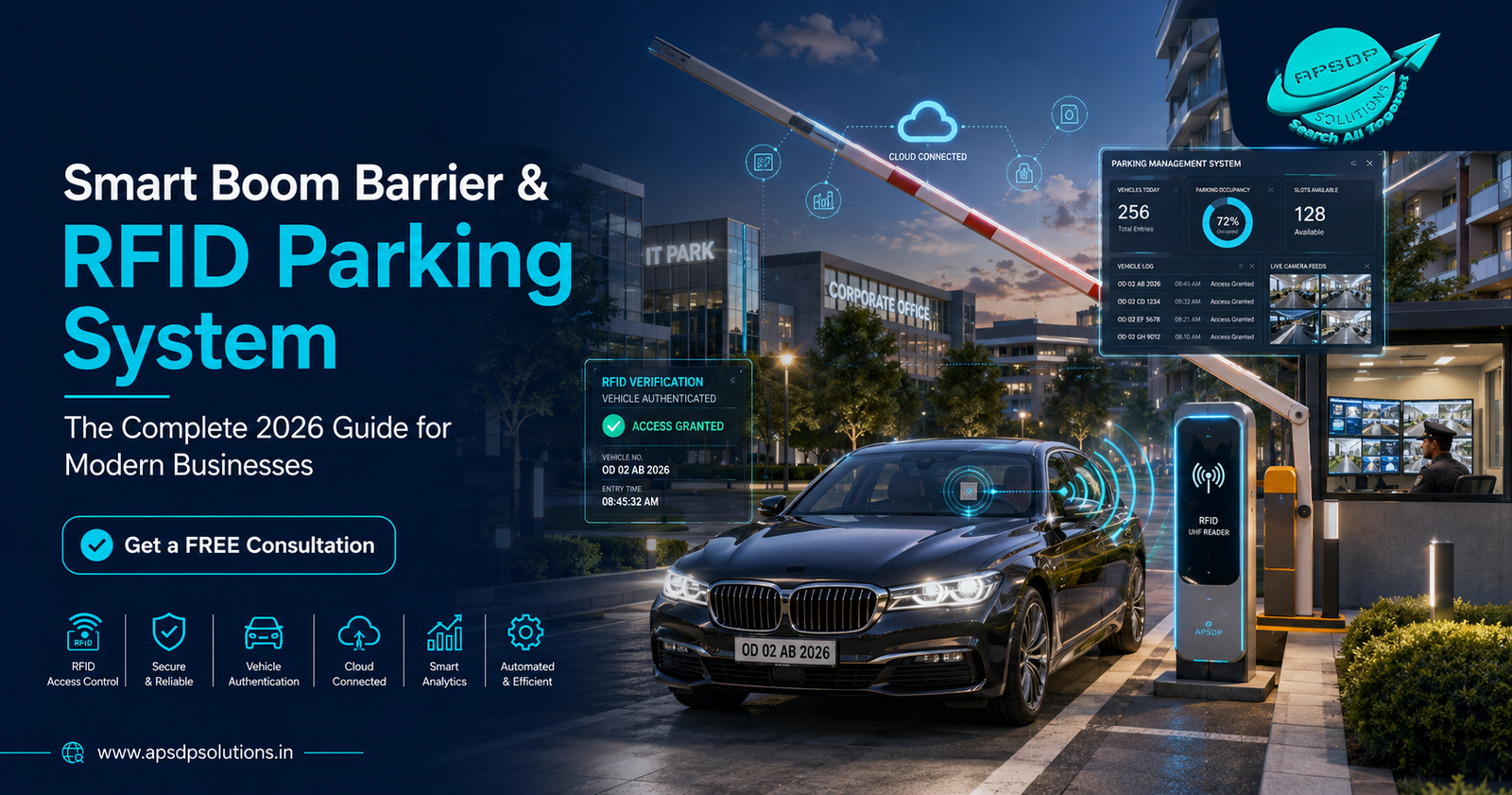
Why Every Modern Business Needs a Smart Boom Barrier & RFID
Introduction
As businesses continue to grow, managing vehicle movement efficiently has become just as important as protecting buildings, employees, and valuable assets. Every day, corporate offices, IT parks, residential communities, hospitals, educational institutions, hotels, manufacturing units, and commercial complexes experience a constant flow of employees, visitors, vendors, and delivery vehicles. Without a structured vehicle access management system, these locations often face traffic congestion, unauthorized entry, security risks, and operational inefficiencies.
Traditional security methods such as manual gate registers, security guards recording vehicle numbers, and manually operated gates are becoming increasingly difficult to manage in today's fast-paced business environment. They consume valuable time, increase operational costs, and often lead to long queues during peak hours.
This is where smart boom barriers and RFID parking systems have transformed modern access management.
A boom barrier acts as the first line of physical security by controlling vehicle entry and exit, while RFID (Radio Frequency Identification) technology automates vehicle identification, enabling authorized vehicles to enter without manual verification. Together, these technologies create a fast, secure, and intelligent parking management solution suitable for businesses of every size.
Organizations across Odisha are increasingly adopting parking automation not only to strengthen security but also to improve visitor experiences, reduce waiting times, enhance operational efficiency, and support future-ready infrastructure.
In this comprehensive guide, you'll learn:
- Why vehicle access control matters
- What a boom barrier is
- How RFID parking systems work
- Why businesses are moving toward parking automation
- Key benefits of integrating boom barriers with RFID technology
- How to choose the right solution for your organization
Why Parking Security Matters More Than Ever
Parking areas are often the first point of interaction with any commercial property. Whether it is a corporate office, apartment complex, IT campus, or industrial facility, poorly managed vehicle movement can create security vulnerabilities and operational challenges.
Common issues businesses experience include:
- Unauthorized vehicle entry
- Long waiting times at gates
- Visitor congestion
- Manual verification delays
- Parking misuse
- Limited vehicle tracking
- Increased dependence on security personnel
- Difficulty maintaining vehicle records
These challenges affect not only security but also employee productivity, customer satisfaction, and overall operational efficiency.
Modern businesses require an intelligent access management system that balances convenience with security.
What is a Boom Barrier?
A boom barrier is an automated gate system designed to regulate vehicle entry and exit at controlled access points. It consists of a motorized barrier arm that opens only when access is authorized.
Boom barriers are commonly installed at:
- Corporate offices
- IT parks
- Apartment complexes
- Educational institutions
- Hospitals
- Hotels
- Shopping malls
- Warehouses
- Manufacturing facilities
- Government buildings
Unlike manually operated gates, automatic boom barriers respond quickly to authorized access requests, reducing waiting time while improving security.
Modern boom barriers can integrate with several technologies, including:
- RFID readers
- Access control systems
- ANPR (Automatic Number Plate Recognition)
- Visitor management software
- Biometric systems
- Security management platforms
This flexibility makes them an essential component of smart infrastructure projects.
Key Components of a Boom Barrier System
A complete boom barrier solution typically includes:
Barrier Arm
The horizontal arm physically controls vehicle movement by opening and closing automatically.
Different arm lengths are available depending on the width of the entrance.
Motor Unit
The motor controls barrier movement smoothly and efficiently.
Commercial-grade motors are designed for continuous operation in high-traffic environments.
Control Panel
The controller manages barrier operations and communicates with connected devices such as RFID readers or access control systems.
Safety Sensors
Modern boom barriers include sensors that detect vehicles or obstacles before closing.
These safety mechanisms help prevent accidental contact and improve operational reliability.
Manual Override
In the event of power failures or emergencies, many systems include manual operation capabilities to maintain access when required.
What is an RFID Parking System?
RFID stands for Radio Frequency Identification.
An RFID parking system uses radio waves to automatically identify authorized vehicles without requiring drivers to stop for manual verification.
Each authorized vehicle carries a unique RFID tag.
When the vehicle approaches the entrance, an RFID reader scans the tag and verifies access permissions.
If authorization is confirmed, the boom barrier opens automatically.
The entire process takes only a few seconds.
This automation significantly improves both security and convenience.
Components of an RFID Parking System
A professional RFID vehicle access solution generally consists of:
RFID Tags
Unique identification tags assigned to:
- Employees
- Residents
- Company vehicles
- Fleet vehicles
- Authorized visitors
Each tag contains a unique identification number.
RFID Reader
Installed near the entrance, the reader detects nearby RFID tags and sends identification data to the control system.
Controller
The controller verifies authorization based on stored access rules.
If the vehicle is approved, the boom barrier opens automatically.
Management Software
Centralized software enables administrators to:
- Register vehicles
- Manage users
- Create access schedules
- View reports
- Track vehicle history
- Monitor entry and exit logs
This information helps improve both operational efficiency and security management.
How Boom Barriers and RFID Work Together
Individually, boom barriers and RFID systems provide valuable functionality.
When integrated, they create a fully automated vehicle access solution.
A typical workflow looks like this:
- An authorized vehicle approaches the entrance.
- The RFID reader detects the vehicle's tag.
- The system verifies access permissions.
- The controller sends an approval signal.
- The boom barrier opens automatically.
- Entry details are recorded in the management software.
- The barrier closes safely after the vehicle passes.
The entire process is fast, reliable, and requires minimal manual intervention.
Why Businesses Are Moving Toward Parking Automation
Modern organizations are under increasing pressure to improve security while delivering better operational efficiency.
Parking automation helps address several common business challenges.
Faster Vehicle Entry
Employees no longer need to stop for manual verification, reducing congestion during peak hours.
Improved Security
Only authorized vehicles are allowed to enter designated premises.
Unauthorized access attempts can be identified more easily.
Better Visitor Experience
Visitors spend less time waiting at entry gates, creating a more professional first impression.
Reduced Manual Work
Security personnel can focus on monitoring and visitor assistance rather than maintaining paper registers.
Digital Record Keeping
Every vehicle movement is recorded automatically, making it easier to review historical access logs whenever required.
Operational Efficiency
Automated systems reduce delays, improve traffic flow, and simplify daily parking management for organizations with high vehicle volumes.
The Growing Demand for Smart Parking in Odisha
As Odisha continues to develop new commercial spaces, IT parks, residential communities, educational campuses, healthcare facilities, and industrial projects, the demand for intelligent vehicle access solutions is increasing.
Organizations are investing in technologies that:
- Improve campus security
- Reduce operational costs
- Enhance visitor experiences
- Support digital transformation
- Prepare infrastructure for future expansion
Smart boom barriers combined with RFID parking systems provide a scalable solution that can adapt to changing operational requirements while helping businesses build safer and more efficient environments.
Benefits of Smart Boom Barrier & RFID Parking Systems
Implementing a smart boom barrier and RFID parking system is about more than simply automating a gate. It transforms how organizations manage vehicle movement, improve security, and optimize daily operations.
Below are some of the most significant benefits businesses can achieve.
1. Enhanced Vehicle Security
Controlling who enters and exits your premises is one of the most important aspects of physical security.
Unlike manually operated gates, an RFID-enabled boom barrier allows only authorized vehicles to access the property based on predefined permissions.
Benefits include:
- Prevents unauthorized vehicle entry
- Improves perimeter security
- Reduces security risks
- Creates a controlled access environment
- Supports visitor verification procedures
For organizations handling sensitive operations or valuable assets, automated vehicle access control provides an additional layer of protection.
2. Faster Entry and Exit
One of the biggest advantages of parking automation is speed.
Manual verification often causes delays during office opening hours, shift changes, or visitor arrival times.
With RFID technology:
- Vehicles are identified automatically.
- Access is verified instantly.
- The boom barrier opens within seconds.
- Traffic moves smoothly.
This significantly reduces congestion and improves the overall experience for employees, residents, customers, and visitors.
3. Reduced Waiting Time
Long vehicle queues create frustration and reduce operational efficiency.
A smart parking system minimizes waiting by eliminating manual entry registers and repetitive identity checks.
This is especially beneficial for:
- IT Parks
- Corporate Offices
- Large Apartment Complexes
- Hospitals
- Educational Campuses
- Industrial Facilities
Efficient vehicle movement contributes to a more organized and professional environment.
4. Improved Operational Efficiency
Automating repetitive tasks allows security teams to focus on higher-value responsibilities.
Instead of manually recording every vehicle, security personnel can concentrate on:
- Visitor assistance
- Emergency response
- Monitoring surveillance systems
- Access exception handling
- Overall site security
Automation helps reduce administrative workload while improving consistency.
5. Digital Vehicle Records
Every vehicle movement can be recorded automatically.
Organizations can maintain detailed logs such as:
- Vehicle ID
- Entry time
- Exit time
- Authorized user
- Access point
- Visit history
Digital records simplify reporting, auditing, and investigations when needed.
6. Better Parking Management
Parking spaces are valuable assets.
An automated system helps businesses:
- Monitor vehicle occupancy
- Improve traffic flow
- Reduce parking misuse
- Allocate reserved parking
- Manage employee and visitor parking separately
This creates a more organized parking environment and supports better facility management.
7. Increased Productivity
Employees should spend their time working—not waiting at entry gates.
Automated vehicle access allows staff to enter the premises quickly, reducing delays during busy hours and improving the overall workplace experience.
8. Professional Brand Image
The entrance is often the first impression visitors have of your organization.
A modern automated entrance with smart boom barriers and RFID access demonstrates:
- Professionalism
- Innovation
- Security awareness
- Operational excellence
This can positively influence clients, partners, visitors, and prospective employees.
Manual Vehicle Access vs Smart Parking Automation
Choosing between traditional gate management and an automated access system has a direct impact on efficiency and security.
| Feature | Manual Vehicle Access | Smart Boom Barrier & RFID |
|---|---|---|
| Vehicle Verification | Manual | Automatic |
| Entry Speed | Slow | Fast |
| Exit Speed | Slow | Fast |
| Human Errors | Higher | Reduced |
| Digital Records | Limited | Automatic |
| Unauthorized Entry Control | Basic | Enhanced |
| Traffic Management | Manual | Automated |
| Scalability | Limited | High |
| Visitor Experience | Variable | Improved |
| Operational Efficiency | Moderate | High |
For organizations expecting growth, automation provides a more scalable and consistent solution.
Is a Smart Boom Barrier & RFID System Right for Your Business?
Parking automation is suitable for organizations that experience regular vehicle movement or require controlled access.
Common applications include:
Corporate Offices
- Employee parking
- Visitor management
- Executive parking
- Secure entry
IT Parks
- Multi-tenant access
- Staff vehicles
- Vendor management
- Parking control
Apartment Complexes
- Resident vehicle access
- Visitor entry
- Delivery vehicle management
- Community security
Educational Institutions
- Faculty parking
- Student vehicle access
- Visitor control
- Campus security
Hospitals
- Staff parking
- Emergency vehicle access
- Visitor vehicle management
- Ambulance movement
Hotels & Resorts
- Guest parking
- Valet operations
- Vendor access
- Service vehicle monitoring
Manufacturing Industries
- Employee entry
- Heavy vehicle access
- Loading and unloading areas
- Contractor vehicle management
Warehouses & Logistics
- Fleet movement
- Dispatch vehicles
- Supplier access
- Loading dock management
Planning Before Installation
Before implementing a parking automation system, organizations should evaluate:
Daily Vehicle Volume
Estimate the number of vehicles entering and leaving the premises during peak and non-peak hours.
Number of Entry & Exit Gates
Large facilities may require separate lanes for entry and exit to maintain smooth traffic flow.
Vehicle Categories
Different access permissions may be needed for:
- Employees
- Visitors
- Contractors
- Delivery vehicles
- Emergency services
Future Expansion
Choose a system that can accommodate additional users, gates, or integrated technologies as your organization grows.
Integration Requirements
Consider whether the parking system should integrate with:
- CCTV surveillance
- Access control
- Visitor management
- Building management systems
- Security software
Planning these integrations early can improve long-term flexibility.
Why Professional Consultation Matters
Every site has unique operational requirements.
A professional assessment helps determine:
- Appropriate boom barrier specifications
- RFID reader placement
- Lane design
- Vehicle flow optimization
- Safety considerations
- Integration opportunities
This ensures the solution aligns with the organization's security objectives and operational needs.
What's Next?
Understanding the benefits of parking automation is the first step.
The next stage is selecting the right boom barrier, RFID technology, and implementation approach based on your facility's traffic patterns, infrastructure, and future requirements.
In the next section of this guide, we'll explore:
- Different types of boom barriers
- RFID technologies and their applications
- Best practices for installation
- Common buying mistakes to avoid
- Frequently asked questions
- Expert guidance on choosing the right solution for your organization
Choosing, Implementing & Maintaining a Smart Boom Barrier & RFID Parking System
Types of Boom Barriers
Not every facility has the same parking requirements. Choosing the right boom barrier depends on traffic volume, lane width, operating environment, and expected usage.
Automatic Boom Barriers
Automatic boom barriers are the most common choice for commercial and institutional premises. They open and close automatically after receiving authorization from an RFID reader, access control system, or other integrated technology.
Best suited for:
- Corporate Offices
- IT Parks
- Residential Communities
- Shopping Malls
- Hospitals
- Hotels
-
Heavy-Duty Boom Barriers
Designed for locations with continuous vehicle movement and high operating cycles.
Ideal for:
- Manufacturing Plants
- Logistics Parks
- Industrial Facilities
- Warehouses
- Toll Plazas
-
High-Speed Boom Barriers
These barriers are engineered to reduce waiting time by opening and closing quickly.
Suitable for:
- IT Campuses
- Business Parks
- Premium Residential Communities
- High-Traffic Commercial Facilities
-
Understanding RFID Technologies
RFID technology is available in different forms depending on the operating range and application.
Passive RFID
Passive tags do not contain an internal battery. They are activated by the RFID reader when the vehicle approaches.
Advantages
- Cost-effective
- Long service life
- Low maintenance
- Suitable for employee and resident vehicles
-
Active RFID
Active RFID tags include an internal power source, allowing them to be detected over longer distances.
Advantages
- Longer reading range
- Faster vehicle detection
- Suitable for large campuses and industrial sites
-
UHF RFID
Ultra High Frequency (UHF) RFID is widely used for vehicle access control because it enables reliable long-range reading.
Common Applications
- Corporate Offices
- Apartment Complexes
- Industrial Parks
- Educational Campuses
- Logistics Facilities
-
Choosing the Right Solution
Selecting the right parking automation solution involves more than purchasing equipment.
Consider the following factors.
Daily Traffic Volume
Estimate:
- Peak-hour traffic
- Employee vehicles
- Visitor vehicles
- Delivery vehicles
- Emergency access requirements
-
Higher traffic volumes often require faster barrier operation and optimized lane design.
Number of Entry & Exit Points
Large premises may benefit from separate entry and exit lanes to improve traffic flow and reduce congestion.
Security Requirements
Determine whether your organization requires:
- Employee-only access
- Visitor authorization
- Time-based access rules
- Vehicle history reports
- Multi-location management
-
Scalability
Choose a solution that allows additional:
- RFID tags
- Boom barriers
- Readers
- Software users
- Access lanes
-
as your organization grows.
Integration Capability
Modern parking systems can integrate with:
- CCTV Surveillance
- Access Control Systems
- Visitor Management Software
- Biometric Attendance
- Building Management Systems
-
An integrated security ecosystem simplifies administration and improves operational visibility.
Installation Best Practices
Professional installation is essential for reliable performance and long-term durability.
Recommended practices include:
- Conduct a detailed site survey.
- Analyze vehicle movement patterns.
- Position RFID readers correctly.
- Install barriers on stable foundations.
- Ensure proper cable routing and protection.
- Configure access permissions.
- Test safety sensors thoroughly.
- Verify opening and closing speeds.
- Train administrators on system operation.
- Schedule preventive maintenance.
-
Proper planning reduces downtime and helps maximize the life of the system.
Maintenance Tips
Routine maintenance helps maintain reliable operation.
Recommended activities include:
- Inspect the barrier arm regularly.
- Clean RFID readers.
- Check electrical connections.
- Test safety sensors.
- Review access logs.
- Update software and firmware where applicable.
- Lubricate moving parts according to manufacturer guidance.
- Replace damaged components promptly.
-
Preventive maintenance is typically more cost-effective than emergency repairs.
Common Buying Mistakes
Many organizations make purchasing decisions based solely on initial price.
Avoid these common mistakes:
Buying Without a Site Survey
Every location has unique traffic flow and security requirements. A professional assessment helps identify the most suitable solution.
Choosing the Wrong Barrier Type
Installing a low-duty barrier in a high-traffic environment can lead to premature wear and reduced reliability.
Ignoring Future Expansion
Businesses often expand parking facilities over time. Selecting scalable solutions helps avoid unnecessary replacement costs.
Poor RFID Reader Placement
Improper positioning can reduce reading performance and affect the user experience.
Ignoring Integration Requirements
Consider future integration with CCTV, access control, visitor management, or other building systems before purchasing.
Selecting Based Only on Price
The lowest-cost option may not provide the durability, performance, or support needed for commercial applications. Consider overall value, reliability, warranty, and after-sales service.
Why Businesses in Odisha Are Adopting Smart Parking Solutions
Organizations across Odisha are investing in parking automation because it helps them:
- Improve vehicle security
- Reduce manual administration
- Enhance visitor experience
- Improve traffic flow
- Strengthen operational efficiency
- Support digital transformation initiatives
-
From apartment communities and IT parks to educational institutions and manufacturing facilities, automated vehicle access has become an important part of modern infrastructure planning.
Why Choose APSDP Solutions
APSDP Solutions provides end-to-end parking automation solutions tailored to the needs of businesses and institutions across Odisha.
Our services include:
- Site Assessment
- Solution Design
- Product Selection
- Boom Barrier Supply
- RFID Parking Systems
- Professional Installation
- System Configuration
- User Training
- Preventive Maintenance
- Technical Support
-
Rather than offering a one-size-fits-all approach, we work with each customer to recommend solutions that match their operational requirements, infrastructure, and future growth plans.
Frequently Asked Questions
What is a boom barrier?
A boom barrier is an automated gate system that controls vehicle entry and exit using technologies such as RFID, access control, or other authorization methods.
What is an RFID parking system?
An RFID parking system uses radio-frequency identification to recognize authorized vehicles automatically and control access through a boom barrier.
Which industries benefit from parking automation?
Corporate offices, IT parks, apartment complexes, hospitals, educational institutions, hotels, warehouses, logistics centers, and manufacturing facilities commonly use these systems.
Can RFID systems record vehicle history?
Yes. Many systems maintain digital logs of vehicle entry and exit times, depending on the software configuration.
Is a site survey necessary?
A professional site survey helps determine suitable equipment, lane configuration, and installation requirements for your premises.
Can the system integrate with CCTV?
Many modern parking automation solutions can integrate with compatible CCTV, access control, and visitor management systems.
How long does installation take?
Installation timelines vary depending on site conditions, the number of entry points, and project complexity.
Are boom barriers suitable for apartments?
Yes. Residential communities commonly use boom barriers with RFID or visitor management systems to improve security and convenience.
How often should the system be maintained?
Routine inspections and preventive maintenance help maintain reliable performance and extend equipment life.
How can APSDP Solutions help?
APSDP Solutions provides consultation, planning, installation, integration, and ongoing support for smart boom barrier and RFID parking solutions across Odisha.
Conclusion
Vehicle access management has become an essential part of modern business infrastructure. Manual entry processes can slow operations, increase administrative work, and create unnecessary security risks.
By combining smart boom barriers with RFID parking systems, organizations can automate vehicle movement, strengthen access control, improve visitor experiences, and create a more efficient parking environment.
Whether you manage a corporate office, IT park, residential community, educational campus, healthcare facility, warehouse, or industrial site, investing in a professionally planned parking automation solution supports both current operational needs and future growth.
Get a Free Consultation
Planning to modernize your vehicle access system?
APSDP Solutions helps organizations across Odisha implement reliable boom barrier and RFID parking solutions through professional consultation, site assessment, solution design, installation, and technical support.
Get a Free Consultation today and discover how smart parking automation can improve security, streamline vehicle access, and create a safer, more efficient environment for your organization.