


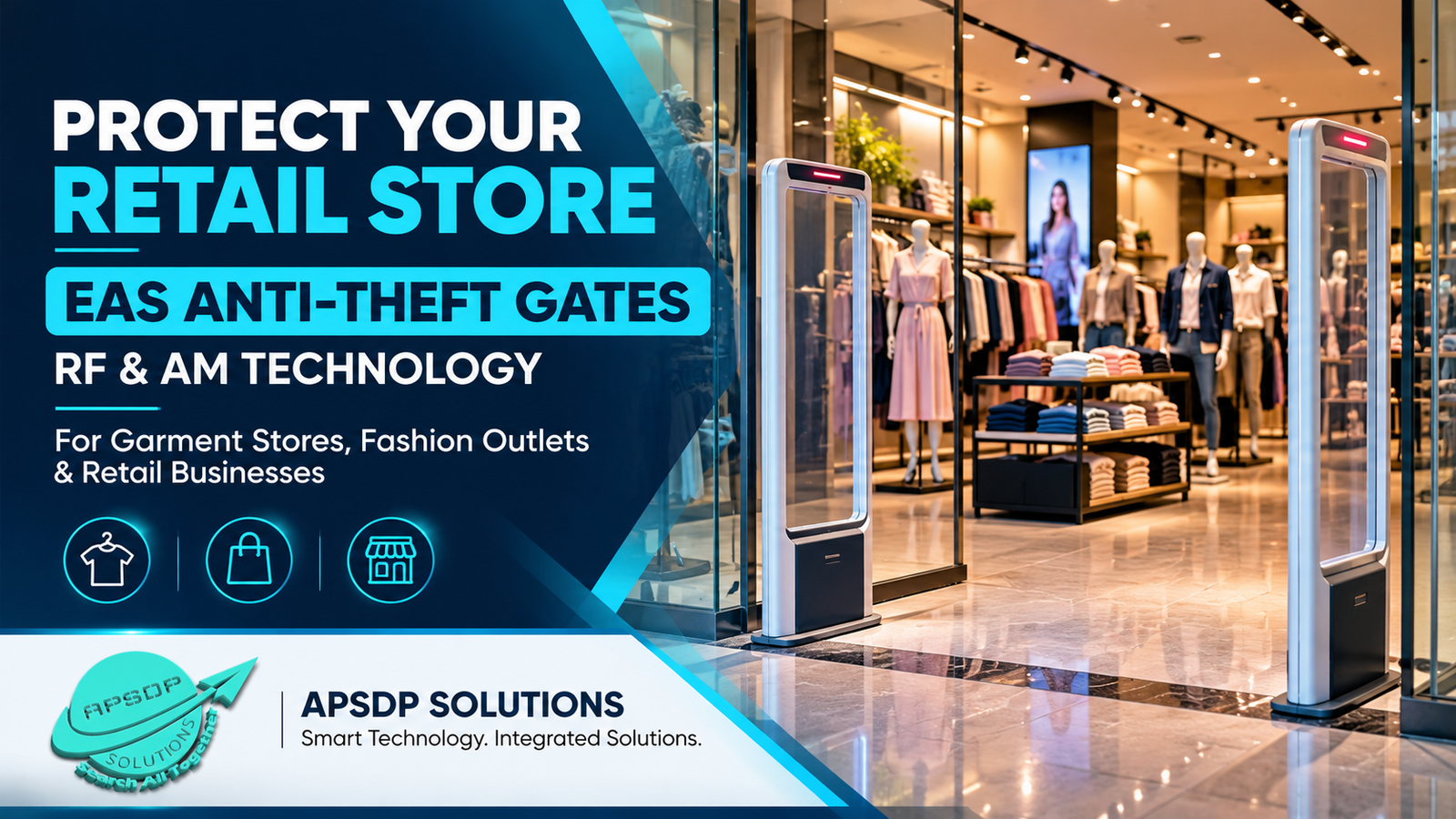
EAS Anti-Theft Gates for Retail Stores: Complete RF & AM Buy
EAS Anti-Theft Gates for Retail Stores: Complete RF & AM Buying Guide
Opening a new garment store, fashion outlet, footwear showroom or supermarket involves many important decisions. Along with store interiors, billing systems, CCTV cameras and inventory management, retailers should also consider how to protect merchandise and improve visibility at store exits.
An Electronic Article Surveillance (EAS) anti-theft gate is a retail security solution designed to detect compatible security tags or labels passing through a monitored exit area. When configured correctly, the system can alert store personnel to a possible removal of tagged merchandise.
For retailers planning a new shop or upgrading an existing outlet, choosing the right EAS system involves more than selecting a gate. Technology type, merchandise, security tags, entrance layout, installation requirements and ongoing support all matter.
APSDP Solutions provides IT hardware, retail technology, security and automation solutions for businesses and institutions across Bhubaneswar and Odisha. This guide explains how EAS gates work, the differences between RF and AM technology, what retailers should evaluate before purchasing, and how to plan a suitable retail security installation.
What Is an EAS Anti-Theft Gate?
EAS stands for Electronic Article Surveillance. It is a technology used in retail environments to help detect merchandise carrying compatible security tags or labels when those items pass through a monitored area.
An EAS installation commonly includes:
-
Detection gates or pedestals: Installed near designated store exits to create a detection zone.
-
Security tags or labels: Attached to or applied to merchandise and compatible with the selected EAS technology.
-
Detachers or deactivators: Used by authorised staff to remove reusable tags or deactivate suitable labels during checkout.
-
Alarm and control components: Provide alerts when the system detects a compatible tag or label under the configured conditions.
The exact components depend on the system and the retailer's requirements.
EAS gates are commonly considered by clothing stores, fashion outlets, footwear retailers, department stores, supermarkets and other businesses selling merchandise that can be tagged.
An EAS system is a loss-prevention aid, not a guarantee against every theft. Correct installation, tag application, checkout procedures and staff awareness remain important.
How Does an EAS Gate Work?
An EAS system creates a detection zone around a store entrance or exit. When merchandise carrying a compatible, active security tag or label passes through that zone, the system may trigger an audible or visual alarm.
A typical workflow looks like this:
-
Apply the security tag or label: Merchandise is tagged according to the retailer's process.
-
Display products for sale: Items remain tagged while available for purchase.
-
Process the sale: Staff use the appropriate detacher or deactivation equipment for the chosen system.
-
Monitor the exit: The EAS gates detect compatible tags or labels that remain active and pass through the detection zone.
-
Respond to alerts: Staff follow the store's established procedure to check an alarm professionally and respectfully.
Detection performance depends on the equipment, tag or label compatibility, installation, product positioning, interference conditions and operating procedures.
Retailers should test the proposed system with their actual merchandise and checkout process before finalising a purchase.
RF vs AM EAS Gates: What Is the Difference?
Two common EAS technologies are Radio Frequency (RF) and Acousto-Magnetic (AM). Both are used for retail merchandise protection, but they use different operating principles and compatible security consumables.
1. RF EAS Gates
RF systems commonly operate at 8.2 MHz, although the exact product specifications must be confirmed with the supplier.
RF solutions may be suitable for retailers using compatible RF security labels and tags. Their suitability depends on the products being sold, tag format, store layout and the specific equipment selected.
Before choosing an RF system, retailers should check:
-
Compatibility with the intended security labels and reusable tags.
-
Detection requirements for the store's merchandise.
-
Available gate designs and suitable passage width.
-
Compatibility with checkout deactivation equipment.
-
Installation conditions and the manufacturer's performance specifications.
2. AM EAS Gates
AM systems commonly operate at 58 kHz. They use compatible AM security tags or labels designed for the selected system.
AM technology may be appropriate for certain retail environments, depending on merchandise, required detection performance, installation conditions and the available compatible consumables.
Before selecting an AM system, retailers should check:
-
Which AM tags or labels are supported.
-
Whether the system suits the merchandise and exit arrangement.
-
Detection performance under the proposed installation conditions.
-
Compatibility with tag removal or label deactivation equipment.
-
Manufacturer guidance, service availability and ongoing consumable costs.
RF vs AM: Which One Should You Choose?
There is no universally best option for every retail store. The correct choice depends on your merchandise, store layout, security requirements, consumables, budget and the specifications of the equipment being offered.
Ask the supplier to demonstrate the proposed system using representative merchandise and compatible tags or labels. Request documented specifications and clarify the conditions under which the stated detection performance is achieved.
Which Businesses Should Consider EAS Gates?
Garment and Clothing Stores
Clothing retailers often handle a wide range of products, including shirts, trousers, dresses, jackets and other apparel. Compatible security tags or labels can be incorporated into merchandise handling and checkout procedures.
For a new garment store, plan the EAS gate location alongside the entrance, billing counter, display racks and customer movement.
Fashion Outlets and Branded Showrooms
Fashion outlets may require a security solution that integrates neatly with premium interiors. Retailers should evaluate gate design, available space, passage width, tag compatibility and the appearance of the installation.
Footwear and Accessories Stores
Footwear, handbags, accessories and similar merchandise may be suitable for EAS protection when compatible tagging methods are available. Confirm the appropriate tag or label format for each product category.
Supermarkets and Department Stores
Larger retail environments may require multiple monitored exits, different tag or label formats, and a coordinated approach to checkout and security procedures.
The system should be planned around actual product categories, exit traffic and the retailer's operational requirements.
Shopping Centres and Multi-Outlet Retail Businesses
Retailers operating multiple branches may wish to standardise their security equipment, tagging processes and staff procedures. Compatibility, maintenance, consumable availability and support arrangements become particularly important when planning across several locations.
How to Choose an EAS Gate for a New Retail Store
If you are preparing to open a new garment store or showroom, evaluate the following factors before requesting a quotation.
1. Identify the Merchandise You Need to Protect
Prepare a list of the products you sell. Clothing, footwear, accessories and packaged goods may require different tag or label formats.
Ask the supplier to recommend compatible consumables for your product categories and demonstrate their practical use.
2. Select the Appropriate RF or AM Technology
Compare the available RF and AM systems against your actual merchandise, required detection performance, installation environment and budget.
Do not select a system based on the technology name alone. Compatibility and real-world testing matter.
3. Plan the Store Entrance and Exit
Gate placement affects customer movement and system performance. Consider the entrance width, nearby metal structures, electrical equipment, billing counter, display racks and customer traffic.
Share your floor plan or entrance photographs with the supplier before finalising the installation.
4. Check Gate Dimensions and Passage Width
The available detection zone and recommended passage width vary by model and installation conditions.
Ask for the manufacturer's specifications and confirm that the proposed arrangement suits the store entrance without creating unnecessary congestion.
5. Check Tagging and Checkout Requirements
Understand how staff will apply tags, remove reusable tags and deactivate compatible labels at the billing counter.
Confirm that all proposed tags, labels, detachers and deactivators are compatible with the selected EAS system.
6. Evaluate Installation and Support
Clarify the installation scope, power requirements, testing process, warranty, maintenance arrangements and availability of replacement components or consumables.
For a new store, coordinate installation with the interior fit-out and opening schedule.
7. Compare the Total Cost
The purchase price of the gates is only one part of the investment. Consider the complete cost of the system, including:
-
Detection gates and required accessories.
-
Initial supply of security tags or labels.
-
Detachers or deactivation equipment.
-
Installation and commissioning.
-
Staff training and operating procedures.
-
Warranty, maintenance and future consumables.
Request a quotation based on your actual requirements rather than comparing equipment prices without checking what each offer includes.
EAS Gates, CCTV and POS: Do They Work Together?
EAS gates, CCTV surveillance and POS billing systems serve different purposes and can complement one another as part of a broader retail security plan.
EAS gates help detect compatible active security tags or labels passing through a monitored exit.
CCTV systems provide video monitoring and may help authorised personnel review incidents, subject to camera coverage, recording settings and applicable privacy requirements.
POS billing systems support checkout and transaction processing. A conventional EAS system should not be assumed to integrate automatically with a POS system; any required integration must be confirmed for the specific equipment.
For a new store, planning these systems together can help avoid poorly placed equipment, inconvenient customer movement and unnecessary installation changes.
Common EAS Gate Buying Mistakes to Avoid
Retailers should avoid these common mistakes:
-
Choosing RF or AM without checking compatibility with merchandise tags and labels.
-
Assuming every security tag works with every EAS gate.
-
Selecting a gate before measuring the store entrance.
-
Ignoring the placement of checkout counters and deactivation equipment.
-
Comparing quotations without checking the installation scope and included accessories.
-
Overlooking recurring consumable costs and after-sales support.
-
Expecting EAS gates to prevent every instance of theft without staff procedures or other appropriate controls.
A careful assessment before purchase can help retailers select a more suitable system for their store.
Frequently Asked Questions About EAS Anti-Theft Gates
What does EAS stand for?
EAS stands for Electronic Article Surveillance. It refers to systems used to detect compatible security tags or labels in retail environments.
What is the difference between RF and AM EAS gates?
RF and AM use different technologies and compatible security consumables. RF systems commonly operate at 8.2 MHz, while AM systems commonly operate at 58 kHz. The appropriate choice depends on the merchandise, equipment specifications, installation environment and required performance.
Are EAS gates suitable for garment stores?
Yes. EAS gates are commonly considered for garment and fashion retail stores when suitable security tags or labels can be used. The selected system must be compatible with the merchandise and store layout.
Can EAS gates be installed in a newly opening shop?
Yes. Ideally, plan the installation during the store fit-out stage so the entrance layout, billing counter, electrical requirements and customer passage can be considered together.
Do EAS gates require security tags?
EAS systems generally rely on compatible security tags or labels to detect protected merchandise. The required consumables and checkout equipment depend on the selected technology and system.
Can an EAS gate connect to a POS or CCTV system?
Some solutions may support particular integrations, but compatibility is model-specific. Confirm any integration requirements with the supplier and equipment manufacturer before purchasing.
How much does an EAS anti-theft gate cost in Odisha?
Pricing depends on the technology, model, number of gates, included accessories, tags or labels, installation requirements and support arrangements. Request a quotation based on your store layout and security requirements.
Where can I get EAS gate solutions in Bhubaneswar or Odisha?
APSDP Solutions provides IT hardware, security and automation solutions for businesses and institutions across Bhubaneswar and Odisha. Contact the company through its website to discuss your retail security requirements and confirm product availability, specifications, installation scope and service coverage.
Plan Your Retail Security with APSDP Solutions
Opening a new garment store, fashion outlet, footwear showroom or supermarket is an opportunity to plan retail security from the beginning.
The right EAS solution should suit your merchandise, entrance layout, tagging process, checkout procedures and budget. Understanding these requirements helps you compare available systems and make a more informed purchasing decision.
APSDP Solutions supports businesses and institutions across Odisha with IT hardware, security systems, automation solutions and retail technology.
Whether you are opening a new store or upgrading an existing outlet, we invite you to discuss your EAS gate requirements, including RF and AM options, compatible security tags, installation planning and related retail technology.
Planning a new retail store? Let's discuss your EAS security requirements.
Visit: https://apsdpsolutions.in/
APSDP Solutions — Smart Technology. Integrated Solutions.
Product specifications, compatibility, availability, pricing, installation and warranty should be confirmed for the selected model before purchase.